
Best Knife Sharpener: 6 Ranked for 2026
The best knife sharpener brings a dull blade back to a razor edge without much skill, because a sharp knife is safer and faster than a dull one you have to force. I let my knives go dull for years before a good sharpener made every cut easier and my prep quicker. The choice comes down to type: an electric sharpener is fastest and most foolproof, a pull-through handheld is cheap and simple, and a rolling sharpener uses a fixed angle for a precise, whetstone-like edge. The keys are how sharp an edge it produces, how easy and safe it is, and value. We ranked six knife sharpeners on all of that. Here’s the one to buy.
What to Look for in the Best Knife Sharpener
Four things separate a great knife sharpener from one that ruins edges:
- Type. Electric sharpeners are fast and foolproof; pull-through handhelds are cheap and simple; rolling sharpeners hold a precise angle magnetically for a fine edge. Pick based on your knives and effort.
- Abrasive quality. Diamond abrasives sharpen fastest and last longest, and a ceramic or stropping stage polishes the edge. Better abrasives mean a sharper, longer-lasting result.
- Angle control. A consistent bevel angle is what makes a knife truly sharp. Adjustable-angle and fixed-angle designs help you match your knives.
- Ease and safety. Ergonomic, stable designs with finger guards keep sharpening safe and simple. Pair a sharpener with our best knives under $100 set.
For a closely related pick, our best bread knife guide is worth a look.
1. Chef’sChoice 15XV EdgeSelect Electric Knife Sharpener
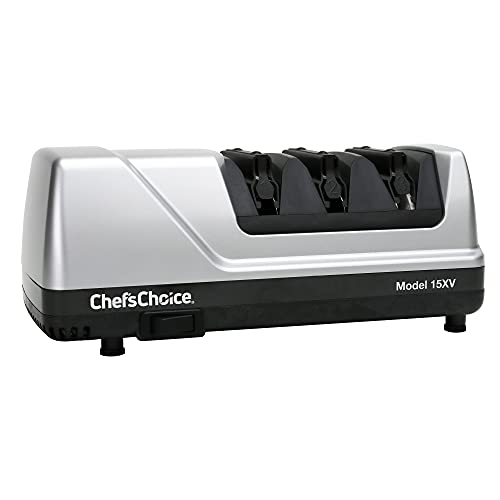
This is the knife sharpener I’d recommend to anyone serious about their edges. The Chef’sChoice 15XV is a professional electric sharpener that converts traditional 20-degree factory edges into high-performance 15-degree edges, giving you a noticeably sharper knife, and it uses 100 percent diamond abrasives plus an advanced stropping stage to sharpen and polish both straight and serrated blades. It’s fast, foolproof, and produces genuinely razor-sharp results without any technique. It’s the most expensive option here, and for a buy-it-for-life electric sharpener the quality earns it. Between the diamond abrasives, the stropping stage, and the effortless results, I think it’s the clear starting point for the best possible edge.
Pros:
– Professional electric sharpening
– 100% diamond abrasives
– Converts to sharper 15-degree edges
– Sharpens straight and serrated blades
– Foolproof, razor-sharp results
Cons:
– Most expensive on the list
– Takes counter and storage space
2. 5 Precision Adjust 3-Stage Knife Sharpener
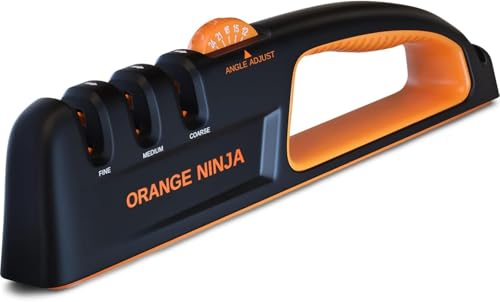
For precise manual sharpening, the Precision Adjust is my pick. It’s an adjustable-angle knife sharpener that gives you a professional-level razor edge, and the adjustable angle is the key, you match the sharpener to your knife’s bevel instead of forcing every blade to one angle. Its 3-stage system takes a dull knife from coarse to fine to polished in sequence, and an ergonomic design makes it extremely easy to use. That combination of angle control and staged sharpening gets you close to whetstone results without the learning curve. It sits at a fair mid price. If you want precise, adjustable manual sharpening, this is the one I’d choose. The angle control genuinely improves the edge.
Pros:
– Adjustable angle for any knife
– 3-stage coarse-to-polished system
– Professional razor edge
– Ergonomic and easy to use
– No electricity needed
Cons:
– Manual effort required
– More setup than a pull-through
3. The Original Tumbler Rolling Knife Sharpener

If you want whetstone-quality results without the skill, the Tumbler rolling sharpener is my pick. It restores factory-sharp edges using a premium diamond-plated disc, and unlike basic pull-through sharpeners, its magnetic angle guide holds the blade at a precise, consistent angle as you roll the disc along the edge, which is what makes the result so clean. It’s the tool that made rolling sharpeners popular, and it produces a genuinely fine edge. It sits at the upper end of the price range. If you love the idea of stone-sharp knives with a foolproof, satisfying process, this is the one I’d choose. The fixed-angle magnet takes all the guesswork out.
Pros:
– Diamond-plated disc for a fine edge
– Magnetic guide holds a precise angle
– Whetstone-quality results, no skill
– Restores factory sharpness
– Satisfying, foolproof process
Cons:
– Pricey for a manual tool
– Slower than an electric sharpener
4. AIERLIAN Rolling Knife Sharpener
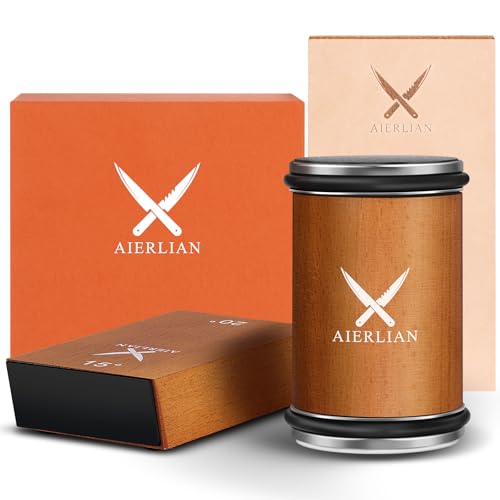
For rolling-sharpener results at a lower price, the AIERLIAN is my value pick. It’s equipped with a #400 diamond disc for sharpening and a #3000 ceramic disc for polishing, so you get both a fresh edge and a refined finish, the same two-step approach as pricier rolling sharpeners. It delivers accurate, long-lasting sharpness that protects the value of expensive knives. It costs well under the Original Tumbler while using the same fixed-angle rolling concept. That combination of diamond-and-ceramic discs and a friendlier price is the draw. If you want the precision of a rolling sharpener without the premium cost, this is the one I’d point you to. The ceramic polishing disc really refines the edge.
Pros:
– #400 diamond and #3000 ceramic discs
– Sharpens and polishes in two steps
– Fixed-angle rolling precision
– Long-lasting sharpness
– Lower price than premium rollers
Cons:
– Lesser-known brand
– Manual, slower than electric
5. AccuSharp Knife Sharpener

For fast sharpening on a budget, the AccuSharp is my pick and a longtime classic. It’s a simple handheld sharpener that gets a sharp edge in about 10 seconds, and it works on chef’s knives, paring knives, serrated blades, and more, so one cheap tool covers your whole block. An ergonomic, comfortable handle and a finger guard make it easy and safe to draw the blade through. At under twelve dollars it’s the lowest-priced sharpener here. That speed and simplicity at a rock-bottom price is the whole appeal. If you want a quick, no-fuss sharpener that just works for the least money, this is the one I’d choose. It’s the definition of good enough for most kitchens.
Pros:
– Lowest price on the list
– Sharp edge in about 10 seconds
– Works on many knife types
– Ergonomic handle and finger guard
– Simple and fast
Cons:
– Coarser edge than diamond systems
– Less angle precision
6. 4-in-1 Kitchen Knife Sharpener
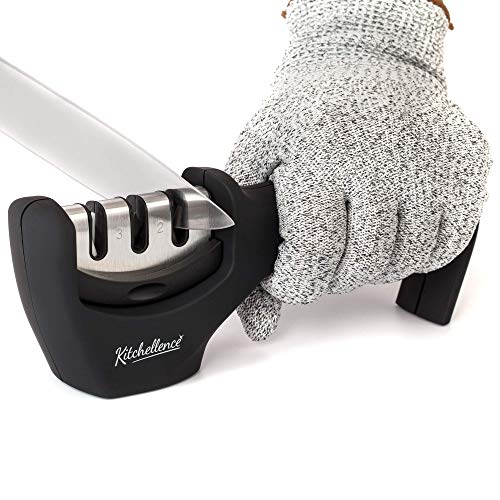
The 4-in-1 sharpener rounds out the list as the multi-function value pick. It’s a 4-in-1 kitchen knife accessory built around a 3-slot system that takes a knife from coarse repair to fine finishing, upgrading simple pull-through sharpening with staged slots. An ergonomic handle works whether you’re right or left-handed, so anyone can restore a cutting edge easily. Getting a staged, multi-function sharpener for under twenty dollars is the draw. It’s a step up from a single-slot sharpener without the cost of a precision system. If you want a versatile, affordable pull-through with multiple stages, this is the one I’d point you to. The staged slots give a better edge than one-pass sharpeners.
Pros:
– 3-slot staged sharpening system
– 4-in-1 multi-function design
– Right and left-handed ergonomic handle
– Easy pull-through use
– Affordable
Cons:
– Pull-through, less precise than rolling
– Lesser-known brand
Which Knife Sharpener Should You Buy?
| If you… | Then choose |
|---|---|
| Want the sharpest, most foolproof edge | Chef’sChoice 15XV (#1) |
| Want precise adjustable manual sharpening | 5 Precision Adjust (#2) |
| Want whetstone results with no skill | Tumbler Rolling (#3) |
| Want a rolling sharpener for less | AIERLIAN (#4) |
| Want fast sharpening on a budget | AccuSharp (#5) |
| Want a staged multi-function tool | 4-in-1 (#6) |
For most people I’d start with the Chef’sChoice 15XV at #1 if you want the sharpest, most effortless results, or the AccuSharp at #5 if you just want a fast, cheap sharpener. Prefer whetstone-quality with no skill, or adjustable manual control? The Tumbler rolling sharpener and Precision Adjust cover those. Whatever you pick, sharpen at a consistent angle and hone regularly between sharpenings. For more, see our best knife sharpening stone and best chef knife guides.
Frequently Asked Questions
What type of knife sharpener is best?
Electric sharpeners like the Chef’sChoice are fastest and most foolproof, giving razor edges with no skill. Rolling sharpeners hold a precise angle for whetstone-quality results. Pull-through handhelds are cheapest and simplest but produce a coarser edge. Choose electric for ease, rolling for precision, and pull-through for budget speed.
How often should you sharpen a kitchen knife?
Most home cooks need to sharpen a knife every few months, depending on use, and hone it with a steel or between sharpenings to realign the edge. If a knife struggles to bite into a tomato or slips off an onion skin, it’s time to sharpen. Regular honing extends the time between sharpenings.
What is the difference between sharpening and honing?
Sharpening removes metal to create a new, keen edge, which you do occasionally with a sharpener or stone. Honing straightens and realigns the existing edge without removing much metal, which you do often, ideally before each use, with a honing steel. Both keep a knife performing at its best.
Can you sharpen serrated knives?
Some sharpeners can. Electric models like the Chef’sChoice 15XV have a stage designed for serrated blades, and specialty tapered rods handle individual serrations. Basic pull-through and rolling sharpeners are made for straight edges and can damage serrations, so check that a sharpener supports serrated knives before using it on them.
Last updated: August 17, 2026. Product availability re-checked.
This page contains affiliate links. As an Amazon Associate we earn from qualifying purchases, at no extra cost to you.